India has millions of young people with the ambition to lead, the education to understand complex problems, and the energy to challenge outdated systems. Yet, for many, becoming a politician remains a career they would rather avoid.
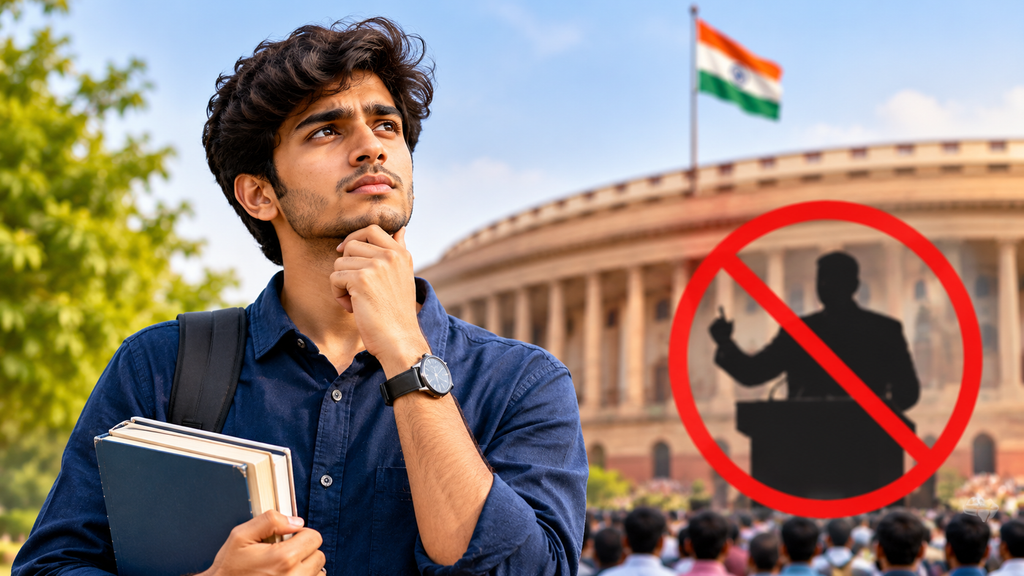
Why?
The answer goes beyond political ideology. It involves financial insecurity, corruption scandals, family connections, bureaucratic failures, and a growing perception that honesty alone may not be enough to succeed in politics.
For a generation raised to value professional qualifications, financial independence, and measurable results, Indian politics can look like a particularly uncertain gamble.
A young person may spend years building expertise in law, technology, economics, or public policy. But entering politics can mean starting without a reliable income, established connections, or a clear path to leadership.
This is where the Generational Divide becomes important. The problem is not simply that young Indians disagree with older politicians. It is that many question whether the political system offers a fair, stable, and respectable professional future.
Politics should attract people who want to improve society. Instead, its public image can discourage precisely those people.
This article examines seven hard truths behind the Generational Divide in Indian politics, including the influence of political dynasties, corruption allegations, criminal cases, administrative failures, and the struggle to build a sustainable political career.
Table of Contents
Hard Truth #1: Political Dynasties Make Entry Difficult
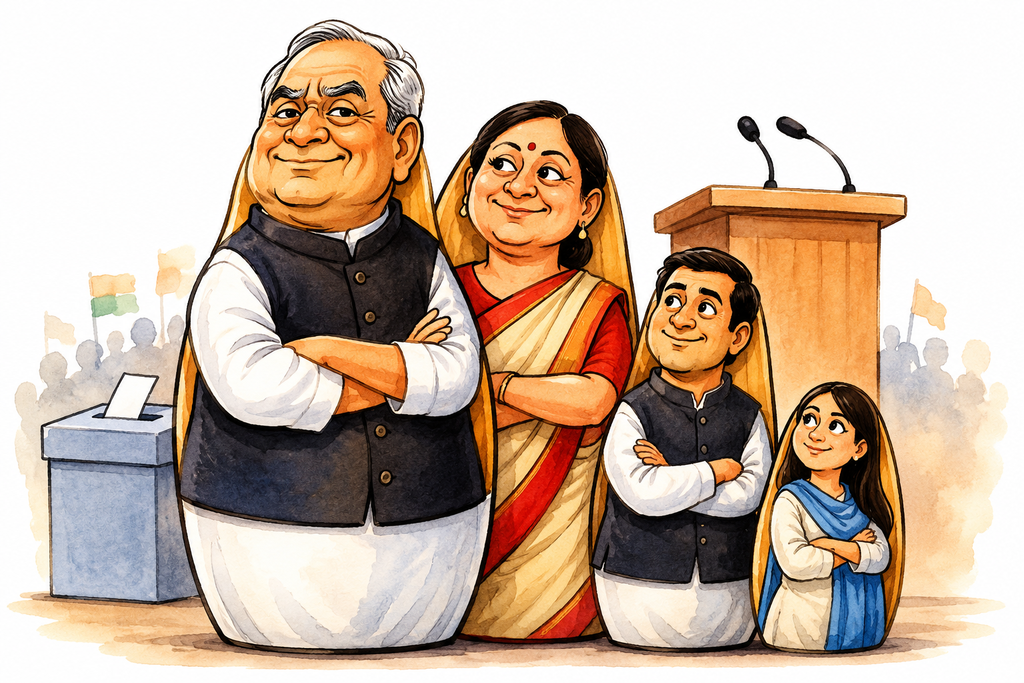
Indian democracy promises citizens the opportunity to choose their leaders. But the ability to enter politics is not distributed equally.
Some aspiring politicians inherit established networks, financial resources, party connections, and public recognition. Others must build their reputations from nothing.
This difference can determine who gets noticed and who remains invisible.
Imagine two young Indians entering politics. One belongs to an influential political family. The other is a qualified graduate with years of experience working on local problems.
Both may have the same ambition. Yet the first candidate could have easier access to party leaders, campaign workers, donors, and established voters.
The second may have to spend years earning recognition without any guarantee of advancement.
This is where the Generational Divide becomes particularly frustrating. Young professionals are often encouraged to believe that dedication, qualifications, and performance create opportunities. When they enter politics, however, they may discover that personal connections can be just as important.
Political families are not automatically incapable of producing good leaders. Some individuals from political backgrounds genuinely work hard and earn public support.
The problem is not family involvement itself. The problem arises when political inheritance becomes a substitute for open competition.
Political parties cannot convincingly promote meritocracy while providing limited opportunities for talented newcomers to advance.
Young people may be welcomed as volunteers, social media managers, and campaign organisers. But meaningful decision-making positions can remain concentrated among established leaders.
India cannot expect young people to invest their futures in a system that appears to value their labour more than their leadership potential.
Parties must create transparent selection procedures, encourage internal democracy, and give grassroots workers a realistic opportunity to advance.
Otherwise, the Generational Divide will continue to grow between young people who want to lead and institutions that appear reluctant to let them.
Hard Truth #2: Corruption Scandals Have Damaged Political Credibility
Few things damage public confidence more quickly than corruption.
Whenever allegations of bribery, financial irregularities, questionable contracts, or misuse of public office emerge, citizens begin questioning whether their representatives are working for the public or protecting their own interests.
For young Indians considering politics, these controversies create a difficult dilemma.
Should they enter a profession they want to reform when its public image is already burdened by suspicion?
The distinction between allegations and proven wrongdoing is essential. Not every politician accused of corruption is guilty. Political opponents sometimes make allegations that require careful investigation, and legal proceedings must determine individual responsibility.
Nevertheless, repeated controversies can weaken public trust, particularly when investigations appear slow or accountability seems inconsistent.
The damage extends beyond individual cases. Citizens may begin to suspect that political influence offers protection from consequences that ordinary people would face.
A young person entering politics with honest intentions can then face an unfair reputational burden. Before demonstrating their abilities, they may have to convince voters that they are different from the politicians they distrust.
This problem becomes even more serious when political parties respond defensively rather than addressing legitimate questions.
An organisation that demands accountability from its opponents should apply comparable standards to its own members.
Public integrity cannot be a campaign slogan that disappears when an allegation involves someone politically useful.
The Generational Divide reflects this loss of confidence. Young people may question whether they can build a respectable career in politics without compromising their principles or constantly defending the actions of others.
India needs stronger financial transparency, credible investigations, effective auditing, and meaningful consequences for proven misconduct.
Political parties must also demonstrate that ethical standards matter more than electoral convenience.
The objective should not be to convince young people that every politician is corrupt. It should be to build institutions where corruption is investigated fairly, wrongdoing is punished appropriately, and honest public service is treated as normal rather than exceptional.
Hard Truth #3: Criminal Allegations Have Created a Damaging Political Image
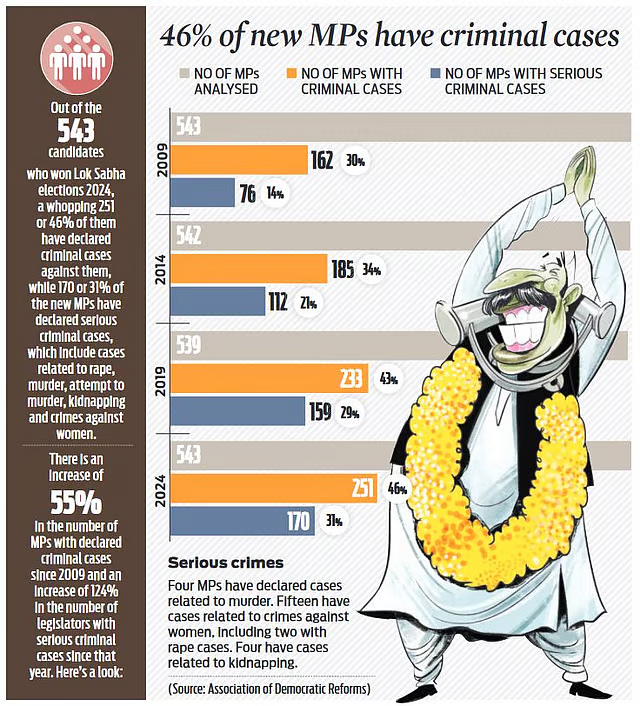
According to the Association for Democratic Reforms (ADR), 251 of the 543 MPs elected to the Lok Sabha in 2024 had declared criminal cases against themselves. ADR also reported that 170 had declared serious criminal cases. These figures concern declared cases and should not be interpreted as proof that every individual involved has been convicted.
The distinction matters. A criminal allegation is not a conviction, and every accused person is entitled to due process.
Perhaps no perception is more damaging to the reputation of Indian politics than the belief that a person needs a criminal background, powerful connections, or a controversial past to become influential.
This perception is too broad to describe every politician. However, election data provides legitimate reasons to examine how parties select their candidates.
Yet the figures raise an important question: why do political parties continue to select candidates facing criminal cases, including serious allegations?
Electoral calculations can play a role. Candidates may have established local networks, substantial resources, strong party backing, or considerable influence within their constituencies.
Some allegations may also be politically motivated. Each case requires individual examination rather than automatic assumptions about guilt.
Nevertheless, when parties repeatedly prioritise electoral strength over serious concerns about candidate suitability, they risk undermining public confidence.
For an ordinary young Indian, the message can be deeply discouraging.
A graduate in law, public administration, economics, or social work may want to enter politics to improve governance. Yet they may believe that a candidate with greater money, influence, or a controversial reputation has an advantage over someone with better qualifications and a stronger commitment to public service.
This is not a healthy foundation for democratic participation.
The Generational Divide becomes sharper when young people begin to associate political success with power rather than integrity.
Political parties must take responsibility for their candidate-selection decisions. They should examine serious allegations carefully, disclose relevant information transparently, and avoid treating criminal accusations as irrelevant whenever a candidate appears electorally useful.
At the same time, judicial processes must remain fair, impartial, and timely.
India should never create the impression that criminality is a shortcut to political success, nor should it allow unproven allegations to become a substitute for justice.
A political system that respects both accountability and due process would give principled young people stronger reasons to participate.
Hard Truth #4: Bureaucratic Failures Make Political Promises Look Empty
Political speeches often promise rapid development, efficient public services, better infrastructure, and employment opportunities.
But citizens judge governments not only by their promises. They judge them by what actually happens after the speeches end.
A road remains unfinished. A public grievance goes unresolved. A recruitment process faces repeated delays. A development project misses its deadline.
For the people affected, the distinction between political ambition and administrative performance becomes painfully clear.
Bureaucratic delays have multiple causes. Departments must coordinate with one another, budgets must be approved, legal procedures must be followed, and public funds require oversight.
These safeguards are necessary. Removing them entirely could create even greater opportunities for arbitrary decisions and corruption.
The real problem arises when procedures become unnecessarily complicated, responsibilities remain unclear, or officials face insufficient pressure to deliver results.
Political leaders also bear responsibility for setting priorities, monitoring implementation, and explaining delays honestly.
Yet the incentives can be frustrating. Announcing a project often generates immediate attention, while maintaining it effectively requires years of less visible work.
For a young person entering politics, this creates a difficult reality.
They may genuinely want to improve local schools, hospitals, roads, or employment services. But once inside the system, they may discover that good intentions are insufficient without administrative cooperation, adequate funding, and effective oversight.
When projects repeatedly stall, public anger frequently falls on elected representatives, even when several institutions share responsibility.
The Generational Divide grows when young people see political careers as opportunities to make promises without possessing the institutional capacity to deliver meaningful results.
Why devote years to a profession if every attempt to solve a problem becomes a battle against delays, unclear responsibilities, and competing interests?
The answer is not to abandon public administration. It is to make it more accountable.
Governments should publish realistic project timelines, clarify departmental responsibilities, strengthen grievance-redress mechanisms, and evaluate performance through measurable outcomes.
Political leaders should also explain the difference between a genuine administrative obstacle and a failure of leadership.
Young Indians need to see that politics can produce practical improvements, not simply dramatic announcements.
When political promises repeatedly fail to become public results, the credibility of the entire profession suffers.
Hard Truth #5: Politics Offers No Guaranteed Financial Security
Financial stability is not a shallow ambition. It is a practical necessity.
Young Indians must consider education costs, family responsibilities, housing, healthcare, and their long-term financial independence.
For many, the decision to pursue a career involves weighing the potential rewards against the risk of losing years without earning a dependable income.
Politics can be particularly difficult in this regard.
A young professional entering a conventional occupation may have access to a salary, opportunities for promotion, and qualifications that can help them move between employers.
An aspiring politician may spend years attending meetings, building relationships, organising campaigns, and supporting a party without securing a stable paid position.
Some political organisations offer salaried professional roles. However, opportunities vary, and grassroots political involvement does not automatically lead to employment or electoral success.
Becoming a party spokesperson, or pravakta, can involve a different set of pressures. The role may demand political knowledge, public speaking, media appearances, and the ability to communicate party positions under intense scrutiny.
Yet access to such opportunities may depend on party structures and leadership decisions.
Electoral politics is even less predictable. A candidate can lose an election after years of preparation. A change in party leadership can affect their prospects, while shifting alliances can alter the political landscape.
A decade of effort does not guarantee a secure future.
India’s wider employment environment makes this calculation especially important. The government’s Periodic Labour Force Survey reported an estimated unemployment rate of 10.2% among people aged 15–29 in 2023–24, using the usual-status measure. This statistic does not measure political-career insecurity, but it highlights why employment prospects matter to young Indians. Press Information Bureau
For someone supporting a family, an uncertain political career may be financially difficult to justify.
This does not mean that politics should guarantee wealth or lifelong employment. Public office is a responsibility, not a personal entitlement.
However, legitimate political work should not be accessible only to people who can afford years without dependable earnings.
Parties can help by establishing transparent recruitment procedures, providing lawful compensation for defined professional roles, and creating opportunities in research, communications, policy development, and constituency management.
The Generational Divide will remain difficult to bridge if young people must choose between participating in politics and maintaining basic financial security.
A serious democracy should make room for public service without requiring financial privilege as the price of entry.
Hard Truth #6: Social Media Has Made Political Life More Punishing
Social media has changed Indian politics. Young people can now communicate directly with voters, explain policy proposals, organise campaigns, and challenge established political figures without relying entirely on traditional media.
That is a significant opportunity.
But the same platforms can make political life exhausting, unpredictable, and personally damaging.
A short video taken out of context can circulate widely. An old statement can return years later. An unverified allegation can spread before the person concerned has an opportunity to respond.
Political disagreements can quickly become personal attacks.
For young professionals considering politics, these risks deserve serious attention. They may want to debate public policy without exposing their entire personal lives to constant scrutiny.
They may also worry that one mistake could damage their professional reputation long after the controversy has ended.
The pressures can be especially difficult for women in public life, who may face gender-based abuse, intimidation, and threats alongside ordinary political criticism.
The problem also affects party spokespersons. A pravakta may be expected to defend party decisions, respond instantly to controversies, and perform convincingly during televised debates.
Sometimes, aggressive confrontation receives more attention than careful explanation.
This creates an unhealthy incentive. Instead of rewarding people who communicate clearly and understand complicated issues, political discussions can reward those who generate the strongest emotional reactions.
The Generational Divide becomes more visible when young Indians recognise the opportunities offered by digital politics but dislike the personal costs attached to public visibility.
Digital communication should make political participation more accessible, not turn it into a permanent contest for attention.
Political parties need clear policies against harassment, better training for young representatives, and responsible procedures for correcting misinformation.
Candidates must also learn to distinguish legitimate criticism from intimidation. Public representatives should expect their decisions to be questioned, but they should not have to tolerate threats or organised personal abuse.
A young Indian should be able to enter politics without accepting that public humiliation is an unavoidable part of the profession.
The future of digital democracy depends on maintaining vigorous political debate while protecting the dignity and safety of those who participate.
Hard Truth #7: Political Parties Often Reward Loyalty Over Competence
Political parties need committed members. Campaigns require coordination, elected representatives must work with colleagues, and organisations need people who can communicate shared policies.
Loyalty is not inherently a problem.
The problem begins when loyalty becomes more important than competence, honesty, or the ability to challenge poor decisions.
Imagine a young economist joining a political party with practical ideas about employment and industrial development.
They have studied the relevant issues and understand the challenges facing local businesses. They may even have developed proposals based on evidence.
But what happens if senior leaders are unwilling to listen because the newcomer lacks influential connections?
Their qualifications may offer little advantage if advancement depends primarily on personal relationships.
This can frustrate educated young Indians who expect professional ability to create opportunities.
Politics does require more than academic qualifications. Effective representatives must understand communities, negotiate disagreements, communicate persuasively, and make difficult decisions.
A degree alone cannot establish political competence.
However, experience should not become an excuse for excluding newcomers or protecting underperforming leaders.
Political parties lose valuable talent when they treat young people as temporary campaign workers rather than future decision-makers.
They may ask young members to organise rallies, manage online campaigns, distribute publicity material, and mobilise voters. Yet those same members may struggle to obtain meaningful responsibilities when leadership positions become available.
This creates a damaging contradiction.
Parties demand youthful energy while sometimes restricting young people’s influence over the decisions that determine their political future.
The Generational Divide widens when aspiring leaders believe that agreeing with influential figures is safer than presenting independent arguments.
Over time, capable individuals may leave political organisations or abandon their ambitions altogether.
The consequences extend beyond individual disappointment. Parties can lose fresh ideas, technical expertise, and a better understanding of changing public expectations.
India needs political organisations that reward constructive disagreement, policy knowledge, community engagement, and measurable achievements.
Transparent promotion criteria, leadership training, internal democratic processes, and genuine opportunities for grassroots advancement would help.
A political party that cannot recognise talent beyond its established inner circle will eventually struggle to attract the next generation of capable leaders.
Young Indians should not have to choose between maintaining their principles and building a political career.
Political loyalty should mean commitment to shared public objectives, not unquestioning obedience to individual leaders.
How India Can Bridge the Generational Divide in Politics
The Generational Divide cannot be resolved by blaming young people for lacking commitment or patriotism.
Many young Indians care deeply about the country’s future. They question government policies, debate economic development, participate in social initiatives, and demand greater accountability.
The challenge is to turn that interest into meaningful participation.
Political parties must begin by opening their internal structures to capable newcomers. Young members should have transparent opportunities to progress from grassroots work into policy development, communications, and leadership.
They should not have to wait indefinitely for recognition from influential figures.
Financial transparency is equally important. Political organisations should establish clear recruitment procedures and lawful compensation for legitimate professional work.
This would help young people participate without relying entirely on personal wealth or family support.
Candidate selection also requires greater scrutiny. Serious allegations should be examined responsibly, relevant information should be disclosed, and political parties should demonstrate that ethical conduct matters.
At the same time, the legal principle that an accused person is presumed innocent unless proven guilty must remain central.
Administrative reform is another priority. Governments need clear responsibilities, realistic project deadlines, accessible grievance mechanisms, and stronger accountability for public-service delivery.
Young politicians should have the opportunity to demonstrate their abilities by solving real problems.
Political organisations must also recognise that not everyone interested in public service wants to contest elections immediately.
Policy research, legislative assistance, community development, political communication, and local governance provide other ways to contribute.
These roles can help young Indians develop expertise before deciding whether electoral politics is the right long-term path.
Representation matters, too. According to the Inter-Parliamentary Union’s data for the 18th Lok Sabha at the start of the legislature in June 2024, only 9.6% of MPs were aged 40 or younger. This is a measure of parliamentary age representation, not direct evidence of young people’s willingness to enter politics. Nevertheless, it highlights the limited representation of younger age groups in the national legislature. IPU Parline
India does not need younger politicians simply for the sake of having younger faces.
It needs leaders who can understand contemporary challenges, listen to citizens, and make responsible decisions.
Bridging the Generational Divide requires political institutions to demonstrate that competence, integrity, and meaningful public service can lead to genuine opportunities.
Young Indians must remain willing to engage with democracy. Political parties, in turn, must give them reasons to believe that participation is worthwhile.
Conclusion: Indian Politics Must Become a Career Worth Choosing
The Generational Divide in Indian politics reflects a serious challenge for India’s democratic future.
Young Indians are growing up in a world where professional skills, financial independence, and institutional accountability matter increasingly to career decisions.
Yet politics can appear to offer uncertain income, unequal opportunities, reputational risks, and advancement that does not always depend on competence.
Corruption scandals can damage public trust. Criminal allegations against elected representatives can raise questions about candidate selection. Bureaucratic failures can weaken confidence in political promises.
Political dynasties and closed party structures can make ambitious newcomers feel that their abilities will never be enough.
These problems should not be exaggerated into claims that every Indian politician is corrupt or that every political organisation excludes talented young people.
India has public representatives who work seriously to improve governance and serve their communities.
But individual examples of good leadership cannot replace institutional reform.
The real concern is that politics may lose capable young Indians not because they lack ambition, but because they see too many risks and too few credible opportunities.
India cannot afford to treat this problem lightly.
A country seeking economic growth, better administration, technological progress, and stronger institutions needs capable people willing to participate in public life.
Political parties must therefore make leadership opportunities more transparent, improve accountability, and create pathways through which young professionals can contribute meaningfully.
They must also accept that criticism is not disloyalty and that public service requires more than electoral success.
The Generational Divide will not disappear overnight. Nor should every young Indian be expected to become a politician.
But those who genuinely want to serve should not feel compelled to abandon that ambition because they fear financial insecurity, institutional barriers, or an environment that appears to reward influence over integrity.
The ultimate test of Indian democracy is not how many young people it can attract to political rallies. It is how many capable young people it can empower to become responsible leaders.
If Indian politics wants the next generation’s trust, it must first demonstrate that honesty, competence, and public service are more than campaign promises.
The future of Indian democracy depends not only on who wins elections, but also on whether the next generation believes that entering politics is a worthwhile choice.