India is standing at an unusual economic moment.
The country has enormous ambitions, a huge young population, expanding infrastructure, a growing digital economy, and increasingly global economic influence. The World Bank reported that India’s economy grew by 7.6% in FY26, making it the fastest-growing major economy during that period. At the same time, the Bank projects growth to moderate to 6.6% in FY27, while warning that external shocks and domestic structural challenges still matter.
That creates an important political question.
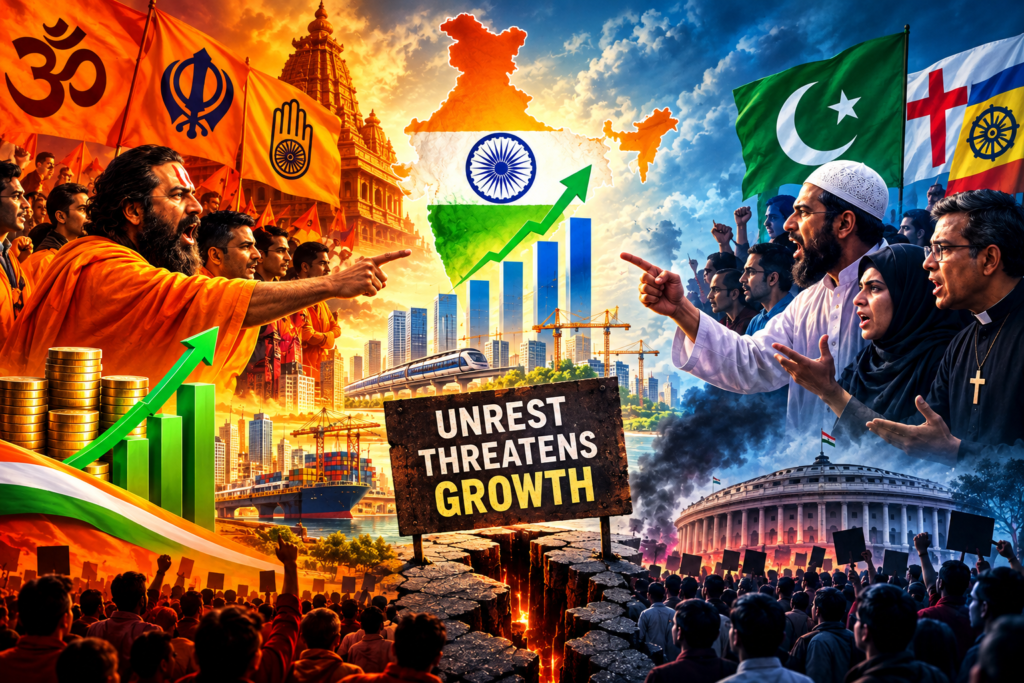
What happens when the national conversation becomes increasingly dominated by identity battles while the economic agenda demands sustained attention to investment, jobs, productivity, manufacturing, education, infrastructure, and human capital?
This is where Religion in Indian Politics becomes more than a question of elections or political rhetoric. It becomes a question about priorities.
The harder question is what happens when religious identity becomes the primary political instrument, while economic and institutional questions receive less attention.
That distinction matters.
When political competition becomes intensely focused on identity, it can consume public attention, deepen social distrust, and make long-term policy discussions harder. Those are risks worth examining rather than dismissing.
This article looks at seven political games surrounding Religion in Indian Politics and asks a simple question: could an increasingly identity-driven political conversation distract India from the growth agenda it needs for the next two decades?
Table of Contents
Religion in Indian Politics: Why the Growth Question Matters
India does not merely need economic growth. It needs sustained growth capable of generating enough productive employment and raising living standards across a vast and diverse population.
The World Bank estimates that around 11–12 million young people enter India’s labour market each year, making job creation one of the central challenges of the country’s next phase of development. Its 2026 partnership framework with India places private-sector-led growth, investment, human capital, infrastructure, and job creation at the centre of the development agenda.
That creates a difficult mismatch.
Political cycles are short.
Economic transformation is not.
A government may have five years to prove itself to voters, while a manufacturing ecosystem can take decades to develop. A new industrial corridor cannot be created overnight. Better universities cannot be built through a campaign speech. Workforce skills cannot be upgraded through hashtags. And productivity cannot be increased simply by winning an election.
This is why Religion in Indian Politics deserves to be examined through the broader question of political priorities.
If elections increasingly reward emotional identity-based campaigning, political actors have an incentive to focus on issues that generate immediate attention. Economic reforms, by contrast, often produce results slowly and sometimes require difficult compromises.
That creates a temptation.
Why spend political capital explaining a complicated labour-market reform when a provocative identity issue can dominate television debates and social media within hours?
That does not mean every religious political issue is a distraction. Some involve genuine constitutional, legal, social, or community concerns and deserve serious debate.
The danger emerges when political competition consistently turns identity into the easiest route to mobilization.
India’s Economic Opportunity Is Too Large to Ignore
India’s economic progress should not be understated.
The World Bank says India’s economy has nearly quadrupled in real terms since 2000, while per-capita income has almost tripled. It also identifies persistent challenges including informality, low female labour-force participation, unequal access to quality services, and regional disparities.
Those challenges require concentration.
India needs more productive jobs.
It needs stronger manufacturing.
It needs better education and health outcomes.
It needs greater female participation in the workforce.
It needs investment.
It needs infrastructure that connects smaller cities and rural areas to larger markets.
And it needs institutions capable of supporting long-term economic confidence.
The World Bank’s 2026 analysis says achieving high-income status would require India to sustain approximately 7.8% average annual real growth over the next two decades, alongside higher investment and stronger labour-force participation.
That is a demanding target.
It leaves little room for political complacency.
Political Game #1 — Turning Religious Identity Into the Main Political Currency
The first political game is straightforward: make identity the central language of political competition.
Every democracy uses identity in some form. Region, language, class, caste, ethnicity, religion, and nationality can all influence political behaviour.
India is no exception.
The problem begins when identity becomes more politically valuable than performance.
A politician can be asked about employment and answer with cultural symbolism. A debate about inflation can become a debate about community identity. A discussion about education can turn into an argument about religious history.
Suddenly, the economic question disappears.
This is particularly powerful because identity is emotional. Economic policy is complicated. A discussion about productivity may require charts, statistics, trade-offs, and years of implementation.
Identity politics can require only a powerful slogan.
That creates an asymmetry.
The more emotionally charged the issue, the easier it can become to dominate public attention.
Yet India’s economic challenges are not waiting.
A young graduate does not experience GDP growth as a percentage on a spreadsheet. The graduate experiences it through the availability of a job, the salary attached to that job, housing costs, transportation, healthcare, and the possibility of building a stable future.
That is why Religion in Indian Politics becomes economically relevant when identity competition begins crowding out performance-based political accountability.
The question voters can reasonably ask is simple: What did this political campaign actually say about jobs, investment, productivity, education, and opportunity?
If those questions become secondary, politics risks becoming disconnected from economic reality.
When Identity Dominates the Development Conversation

The issue is not religion itself.
Faith communities contribute enormously to Indian society. Religious institutions can provide education, charity, healthcare, community support, and social services.
The concern is political exploitation of identity.
When politicians repeatedly present elections as contests between communities, the incentive structure changes. Politicians may find greater rewards in defining who belongs, who is threatening whom, and which historical grievance should dominate the news cycle.
That can make development politics harder.
A country trying to build a globally competitive economy needs citizens, businesses, workers, and investors to think beyond immediate political confrontation.
Economic transformation requires cooperation across communities because factories employ people from different backgrounds, supply chains cross states, universities bring together students from different regions, and national infrastructure connects diverse populations.
A fragmented political environment can make that cooperation more difficult.
The risk is not necessarily an immediate fall in GDP.
The more subtle risk is lost political attention.
Political Game #2 — Using Religious Polarization to Mobilize Voters
The second political game is polarization.
Polarization can be electorally effective because it simplifies politics.
Instead of asking voters to evaluate dozens of policy questions, political campaigns can frame the election around a single emotional conflict.
Who is protecting your identity?
Who is threatening your community?
Who belongs to the nation?
Who does not?
These questions can produce strong political reactions.
But they can also make policy discussion increasingly binary.
That is dangerous for a country with India’s scale.
India contains enormous religious, linguistic, regional, cultural, economic, and social diversity. A political system that constantly pushes citizens toward opposing identity camps risks making compromise more difficult.
And compromise is not weakness in economic policymaking.
Major reforms frequently require negotiation.
Land, labour, taxation, education, energy, infrastructure, trade, and urban development all involve competing interests. Governments need businesses, workers, states, local communities, and civil society to cooperate.
If political debate becomes permanently confrontational, even reasonable reforms can become politically toxic.
This is one reason Religion in Indian Politics should not be examined only through election results. It should also be examined through the quality of public debate.
Does political competition encourage better policy?
Or does it reward whoever can generate the strongest emotional reaction?
That is a question for voters, journalists, researchers, and political institutions to consider.
The Cost of a Permanently Divided Political Conversation
Polarization does not automatically destroy economic growth.
India’s recent growth performance itself demonstrates why simplistic conclusions should be avoided. The World Bank recorded 7.6% growth in FY26, even amid substantial global uncertainty.
But economic resilience today should not be confused with unlimited resilience tomorrow.
India is trying to attract investment into manufacturing, technology, infrastructure, renewable energy, logistics, healthcare, tourism, and other sectors. The World Bank has specifically emphasized the importance of a predictable, business-enabling environment for investment and large-scale job creation.
Predictability matters.
Businesses can tolerate political disagreement.
They can operate under different governments.
What they need is confidence that rules, institutions, contracts, markets, and public administration will remain sufficiently predictable.
Political polarization becomes economically relevant when it begins affecting that environment.
Political Game #3 — Letting Culture Wars Overshadow Economic Priorities
The third political game is the culture-war cycle.
Culture wars are powerful because they provide endless content.
One statement produces a response. The response produces another statement. Television debates follow. Social media explodes. Political supporters mobilize. Opponents respond.
And then another issue arrives.
The economic agenda, meanwhile, continues quietly in the background.
This creates an unusual political economy.
The issues most important for India’s future may not be the issues receiving the most attention.
A reform that improves productivity by 5% over several years may receive less attention than a controversy that generates millions of social-media interactions in a single day.
That does not make the controversy irrelevant.
It simply raises a question about proportion.
India’s policymakers have an enormous list of economic tasks. The World Bank identifies investment, productivity, labour-force participation, manufacturing, human capital, and structural reforms as central to India’s ambition of reaching higher income levels.
These are not glamorous topics.
But they determine living standards.
A country cannot become prosperous through political attention alone. It needs physical infrastructure, skilled workers, productive firms, technological innovation, financial investment, and institutions capable of implementing policy.
If Religion in Indian Politics becomes the dominant lens through which every political issue is interpreted, those practical questions can become secondary.
And that would be a costly distraction.
Political Game #4 — Treating Every Communal Flashpoint as an Electoral Opportunity
The fourth political game appears when a local or regional communal controversy becomes national political ammunition.
India is too large for every conflict to remain local.
A statement made in one city can become national news within hours. A dispute involving two communities can become a political symbol thousands of kilometres away.
Social media accelerates this process.
The political temptation is obvious.
A local controversy can be used to demonstrate that a particular party or community is under threat. Another political actor can respond by presenting itself as the defender of the opposing side.
The original issue then becomes part of a much larger political narrative.
This cycle can make rational discussion harder.
The public may no longer debate what actually happened. Instead, people debate what the incident supposedly represents.
That distinction matters.
A country of more than a billion people will inevitably experience local disputes, disagreements, crimes, protests, and communal tensions. The national political system has to decide whether each incident becomes another battlefield in a permanent identity conflict.
When every incident is nationalized, politics can become permanently reactive.
Why Local Tensions Can Become National Political Issues
The economic implications are indirect but important.
Businesses need customers who can move freely. Workers need safe workplaces. Tourists need confidence. Students need functioning educational environments. Supply chains need reliable transportation.
Persistent social tension can create costs even when those costs are difficult to quantify.
That is why responsible political leadership matters across party lines.
The point is not to suppress political disagreement.
The point is to prevent every disagreement from becoming a referendum on the identity of an entire community.
Religion in Indian Politics will remain part of India’s democratic reality. The challenge is ensuring that religious identity does not become an excuse for treating millions of citizens as permanent political opponents.
Economic development requires a broader social compact.
Political Game #5 — Social Media, Misinformation, and the Speed of Outrage

The fifth political game is perhaps the newest.
It is the politics of virality.
A political speech once travelled through newspapers, television, rallies, and word of mouth.
Today, one thirty-second video can reach millions.
That changes political incentives.
Social media rewards content that creates reactions. Anger often travels faster than nuance. A complicated economic explanation may struggle for attention, while a provocative religious claim can dominate the conversation.
This creates an information problem.
Citizens are expected to make political decisions in an environment where information arrives faster than verification.
The danger is especially serious when religious identity is involved.
A misleading claim about a community can trigger outrage before anyone checks whether it is true. A clipped video can remove context. An old photograph can be presented as a new event. A fabricated statistic can circulate as fact.
Once a claim becomes emotionally important, correcting it becomes much harder.
Why Viral Politics Can Distort Public Priorities
This does not mean social media is inherently harmful.
Digital platforms also give citizens unprecedented access to information. They allow journalists, researchers, activists, businesses, and ordinary people to communicate directly with audiences.
The problem is the incentive structure.
If political actors learn that outrage generates engagement, outrage becomes politically valuable.
That can produce a vicious cycle.
Politicians generate provocative content.
Supporters amplify it.
Opponents respond.
Algorithms distribute it further.
Traditional media covers the online controversy.
The controversy then returns to social media.
The economic policy discussion gets pushed aside.
This is where Religion in Indian Politics intersects with the modern attention economy.
India’s growth ambitions require serious public conversations about manufacturing, trade, education, artificial intelligence, energy, infrastructure, employment, healthcare, and productivity.
Those topics rarely fit into a viral clip.
But India’s future depends on them.
Political Game #6 — Making Institutions Part of Permanent Political Warfare
The sixth political game concerns institutions.
Democracy is more than elections.
It depends on courts, legislatures, election institutions, public administration, universities, media organizations, regulators, and other bodies performing their functions with credibility.
Political disagreement is normal.
Institutional distrust becoming permanent is different.
When every institutional decision is interpreted entirely through partisan or religious loyalty, public confidence can weaken.
One side may see an institution as biased.
The other side may see the same institution as necessary.
The result is a political environment where institutional legitimacy itself becomes another battlefield.
That is not simply a political problem.
It can become an economic problem.
Investors care about predictable rules. Businesses care about contract enforcement. Entrepreneurs care about regulation. Workers care about employment protections. Citizens care about whether public services are delivered fairly.
The World Bank’s current India strategy repeatedly emphasizes reforms, private investment, human capital, and a business-enabling environment as important to future growth.
Institutional Credibility and Investor Confidence
It would be excessive to claim that religious political rhetoric automatically causes investors to leave.
Investment decisions are much more complicated.
But institutional credibility is one part of the broader environment in which investment decisions are made.
If political conflict makes policy unpredictable, implementation becomes harder.
If public debate becomes dominated by accusations of institutional capture, trust can weaken.
If regulatory questions become permanently politicized, businesses may become more cautious.
None of this means political institutions should avoid scrutiny.
Quite the opposite.
Strong institutions should be scrutinized.
The distinction is whether scrutiny strengthens accountability or turns every institution into another permanent political battlefield.
India’s economic ambitions require institutions that can survive political cycles.
That is bigger than any individual party.
Political Game #7 — Forgetting the Voter’s Economic Clock
The seventh political game is perhaps the most important.
It is forgetting that voters have economic problems that cannot be postponed indefinitely.
A family may care deeply about religion and culture.
It may also care about rent.
It may care about school fees.
It may care about food prices.
It may care about healthcare.
It may care about a young person’s first job.
It may care about whether a small business survives.
People can hold strong cultural identities while simultaneously demanding economic results.
Political parties should not assume that identity automatically replaces economic priorities.
India’s growth challenge makes this especially important.
The World Bank says India needs stronger investment and productivity and estimates that achieving high-income status would require sustained rapid growth over the coming decades. It also highlights the need to increase labour-force participation, particularly among women.
That means the political clock and economic clock must eventually meet.
Jobs, Skills, Prices, and Opportunity
Imagine a young Indian graduate entering the workforce.
The graduate may have strong religious beliefs.
The graduate may care about national identity.
The graduate may have a political preference.
But eventually there is another question:
Where is the opportunity?
That question cannot be answered through cultural symbolism.
It requires businesses capable of hiring.
It requires workers with relevant skills.
It requires investment.
It requires functioning infrastructure.
It requires access to finance.
It requires markets.
And it requires policy continuity.
The World Bank’s June 2026 financing program for India focuses specifically on structural reforms intended to improve the business environment, trade and investment openness, private capital mobilization, and job creation. The institution says around 11 million young people are expected to enter India’s labour market each year over the next two decades.
That number puts the political debate into perspective.
India cannot afford a politics that asks young people to choose endlessly between identities while giving insufficient attention to their economic future.
What Religion in Indian Politics Should Not Overshadow
The central argument is not that religion should disappear from Indian public life.
That would be unrealistic and incompatible with India’s social reality.
The better question is whether political competition can make room for both identity and development without allowing one to permanently overwhelm the other.
India’s economic agenda is enormous.
It includes manufacturing.
It includes artificial intelligence and digital technology.
It includes energy security.
It includes infrastructure.
It includes education.
It includes healthcare.
It includes women’s participation in the workforce.
It includes urbanization.
It includes agricultural productivity.
It includes trade.
It includes entrepreneurship.
It includes millions of young people searching for meaningful employment.
These issues do not produce instant political gratification.
But they determine India’s position in the global economy.
The World Bank’s current framework for India focuses on private-sector-led job creation, structural reform, infrastructure, human capital, rural prosperity, urban transformation, and sustainable development.
That is the kind of long-term agenda that needs sustained political attention.
The danger of Religion in Indian Politics is therefore not simply that religion enters political debate.
The deeper danger is that political competition becomes so consumed by identity that development becomes background noise.
India has already demonstrated that rapid growth is possible.
The challenge now is sustaining it while addressing deeper structural weaknesses.
That requires political maturity from everyone involved.
Governments must deliver.
Opposition parties must scrutinize.
Media organizations must inform.
Citizens must evaluate claims.
Institutions must remain credible.
And voters must continue asking questions about economic performance alongside identity and ideology.
Conclusion — Can India Keep Growth Ahead of Political Distraction?
India’s growth story is too important to reduce to a battle between political camps.
The country has enormous economic potential, but potential is not destiny.
The World Bank’s 2026 assessments show both sides of the picture: India recorded strong 7.6% growth in FY26, yet the outlook includes slower projected growth and significant structural challenges. The institution also argues that India needs stronger investment, productivity, job creation, human capital, and reforms to achieve its longer-term ambitions.
That is the bigger story.
Religion in Indian Politics will remain an important subject because religion remains an important part of Indian society and political life.
But political debate does not have to become a zero-sum contest.
A country can protect religious freedom while pursuing economic growth.
It can debate cultural questions while discussing employment.
It can argue about history while investing in the future.
The real test is whether political competition helps citizens solve problems or simply gives them new reasons to fight.
India’s next stage of development will require patience.
It will require investment that may take years to pay off.
It will require reforms that may initially be unpopular.
It will require businesses willing to invest for the long term.
It will require workers who can adapt to changing technology.
And it will require political leaders capable of looking beyond the next viral controversy.
The seven political games discussed here should therefore be understood as risks and patterns to examine, not as proof that religion itself is responsible for economic outcomes.
India’s future will be shaped by many forces.
But one question will remain increasingly difficult to avoid:
Can India keep its political passions from overwhelming the economic priorities that will determine its prosperity?
Read More of Our Work in Real Hard Politics:
What Was the Traditional U.S. Position on Kashmir?
What Was the Traditional U.S. Position on Kashmir? Learn How America approached the Kashmir dispute, its History and its implications on India-Pakistan.
Indian Opposition: 7 Red Flags That Could Overshadow India’s Growth
Learn More about the state of the Indian Opposition and how their ways at the present may cause the country’s growth. Indian Opposition faces 7 critical questions as political battles risk overshadowing India’s growth agenda, parliamentary debate, and national priorities.
India Economic Growth: 7.8% Surge Defies Global Turmoil and Delivers a Powerful Economic Victory
Here we dive into Indian Economy: India Economic Growth reaches a powerful 7.8% surge, defying global turmoil and highlighting India’s economic resilience, strong domestic demand, and growing role in the global economy.
America’s Kashmir Version: The Evolution Of U.S. Policy toward Jammu & Kashmir — From Cold War diplomacy and India-Pakistan Mediation to Washington’s Increasingly India-centric Strategic Relationship and the 2026 Srinagar moment
America’s Kashmir Version: Explore how U.S. policy toward Jammu & Kashmir evolved from Cold War mediation to strategic India-centric approach.