A routine commercial flight suddenly became a terrifying fight for survival on September 30, 2026.
Flydubai Flight FZ1073 was travelling from Dubai to Tel Aviv when an extraordinary crisis unfolded inside the cockpit. According to authorities and multiple reports, Captain Smit Machchhar, an Indian pilot, was attacked and stabbed by his co-pilot while the Boeing 737 was in flight.
The aircraft then went into a dramatic descent.
What happened next was not a story of one person alone. It was a remarkable chain of courage involving the injured captain, passengers, cabin crew and two off-duty pilots who happened to be travelling on the aircraft.
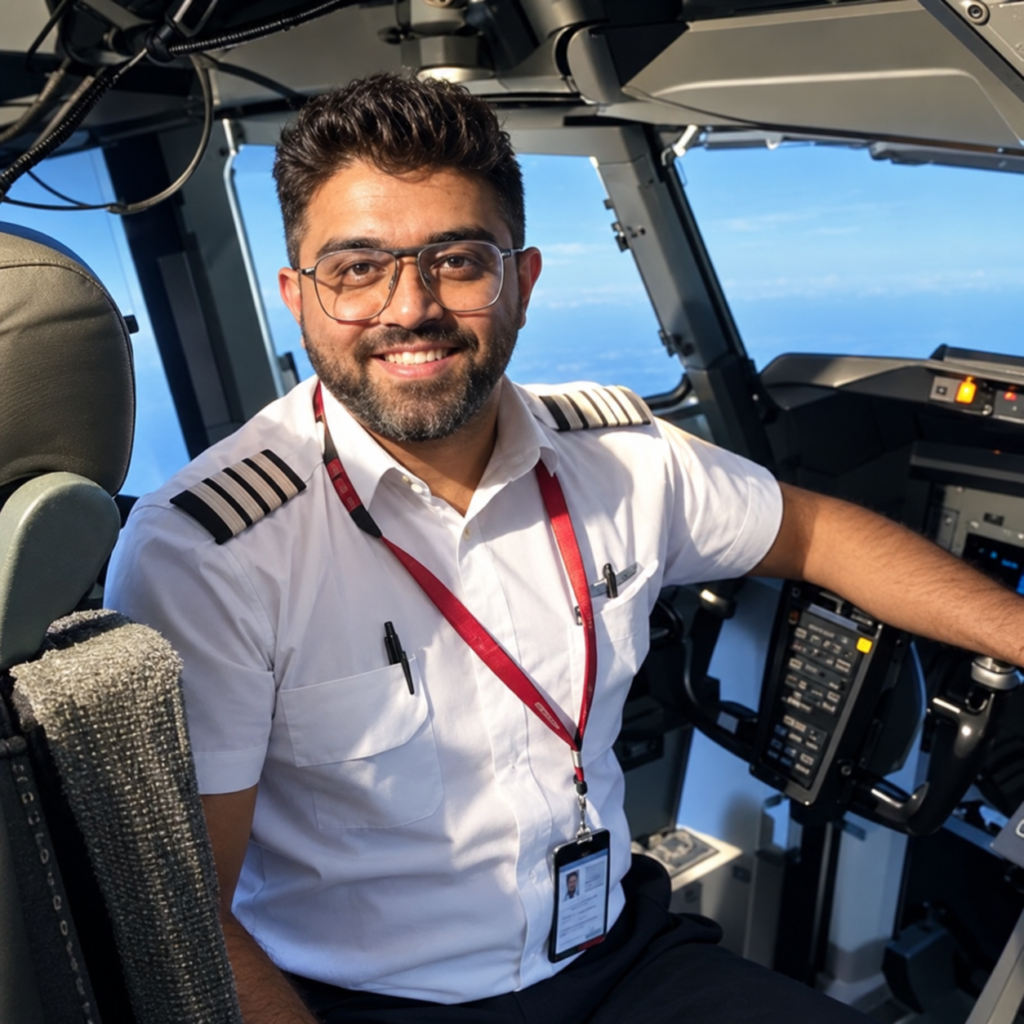
But Captain Machchhar’s actions came at the critical moment.
Despite being seriously wounded, he resisted the attacker and managed to open the reinforced cockpit door. That allowed passengers and crew members to enter, restrain the attacker and help restore control of the aircraft. The plane was subsequently diverted and landed safely at Tabuk, Saudi Arabia. Reuters reported that all 174 passengers were unharmed.
That is why How an Indian Hero Saved 180 Lives has become a powerful description of an incident that could have ended with catastrophic loss of life.
There is one important numerical clarification: 174 passengers were reported aboard the flight, while some media reports and passenger accounts have referred to roughly 180 people or “180 lives.” This article uses the popular phrase How an Indian Hero Saved 180 Lives because it is the focus keyword, while using the documented 174-passenger figure when referring to the confirmed passenger count.
Table of Contents
How an Indian Hero Saved 180 Lives
The phrase How an Indian Hero Saved 180 Lives captures the extraordinary courage displayed by Captain Smit Machchhar, but the full story is even more compelling.
The captain was reportedly stabbed by his co-pilot while the aircraft was airborne.
This was not an ordinary cockpit emergency.
According to Reuters, the aircraft lost nearly 14,000 feet in less than 30 seconds during the crisis. The rapid descent demonstrated just how serious the situation had become.
Yet Machchhar did not simply surrender to his injuries.
Reports say he fought back and, despite being seriously wounded, managed to unlock the cockpit door.
That single action changed everything.
Passengers and crew were then able to enter the cockpit and overpower the attacker. Two off-duty pilots who were travelling as passengers also became involved in helping regain control of the aircraft before the emergency landing in Saudi Arabia.
The significance of those seconds cannot be overstated.
A cockpit is deliberately designed to be isolated from the passenger cabin. That security exists to prevent unauthorised access, particularly after the September 11 attacks transformed global aviation security.
In this case, however, the injured captain’s decision to open the door created the opportunity for others to intervene.
That was an extraordinary act of courage under circumstances where every second mattered.
A Terrifying Attack Inside the Cockpit
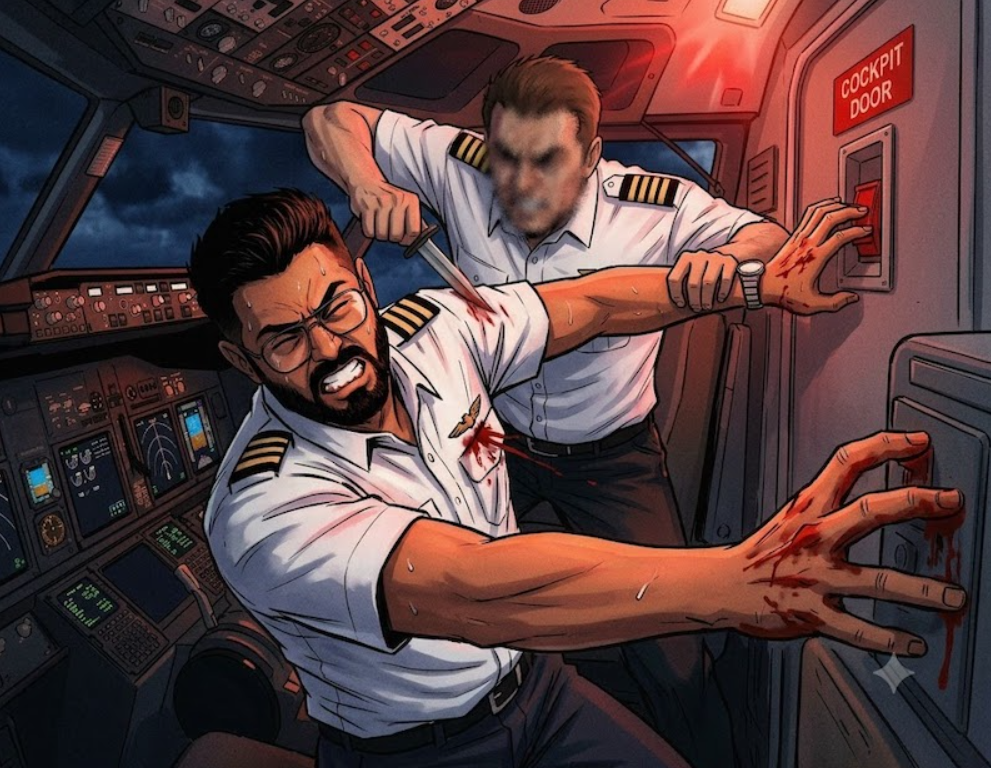
The alleged attack began where passengers normally have no access: inside the cockpit.
According to Reuters and other reports, the co-pilot allegedly stabbed Machchhar and attempted to take control of the aircraft. The motive remains under investigation, and authorities have not yet established every detail of what happened or why.
The distinction is important.
The incident has been described by Israeli officials as an apparent attempted terrorist attack or attempt to crash the aircraft. But the investigation is still developing, and claims about motive should therefore be attributed to the authorities rather than presented as established fact.
What is beyond dispute is the seriousness of the alleged conduct.
A violent attack against a pilot inside an airborne commercial aircraft creates an extraordinary danger to everyone aboard.
A passenger cannot simply leave.
There is no roadside emergency exit.
There is no hospital nearby.
There is nowhere for the aircraft to stop.
For that reason, any deliberate attempt to seize control of a passenger aircraft is an exceptionally grave threat.
If investigators ultimately establish that the incident was a deliberate attempt to crash the aircraft, it would represent an especially disturbing form of mass-casualty violence.
The Moment Captain Machchhar Refused to Give Up
This is where the story of How an Indian Hero Saved 180 Lives becomes deeply human.
Captain Machchhar was not an abstract symbol.
He was a professional pilot suddenly placed in an unimaginable situation.
He was injured.
He was bleeding.
And yet he continued to act.
The most consequential reported action was his ability to open the cockpit door. The Indian Express reported that this allowed passengers and crew to reach the cockpit and overpower the attacker.
That decision created a bridge between the cockpit and the cabin.
On one side was an injured pilot.
On the other were passengers who suddenly understood that something was desperately wrong.
They crossed that bridge.
They acted.
And the crisis began to turn.
This is why the story should not be reduced to a simple “pilot versus attacker” narrative.
Machchhar’s bravery created the opening.
Passengers responded.
Other pilots helped.
A dentist aboard the aircraft reportedly provided medical assistance to the injured captain.
And eventually the aircraft was brought safely to the ground.
Several people therefore played a role in preventing catastrophe.
But the captain’s resistance was a crucial first link in that chain.
International Praise for Captain Smit Machchhar
The response has been unusually strong across international reporting.
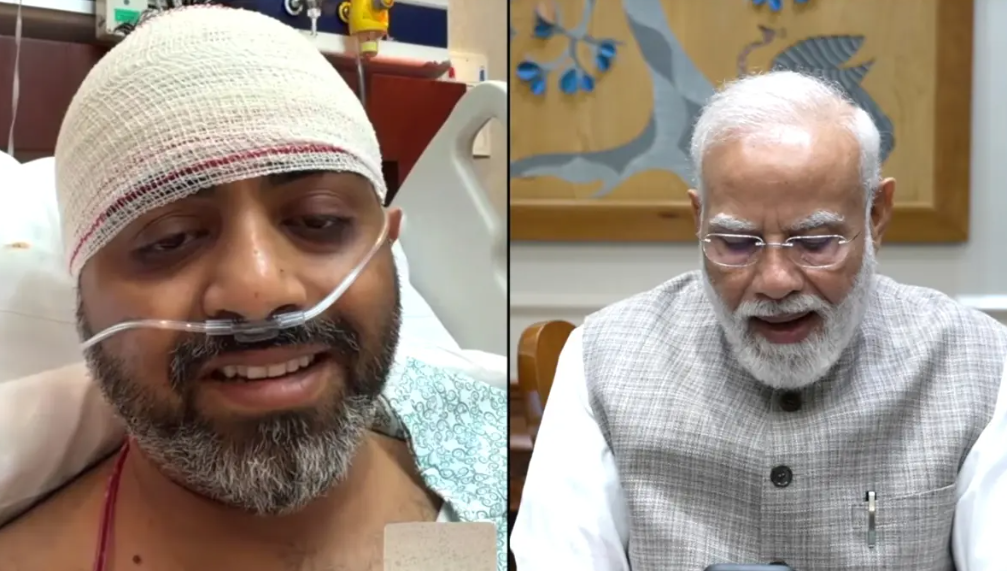
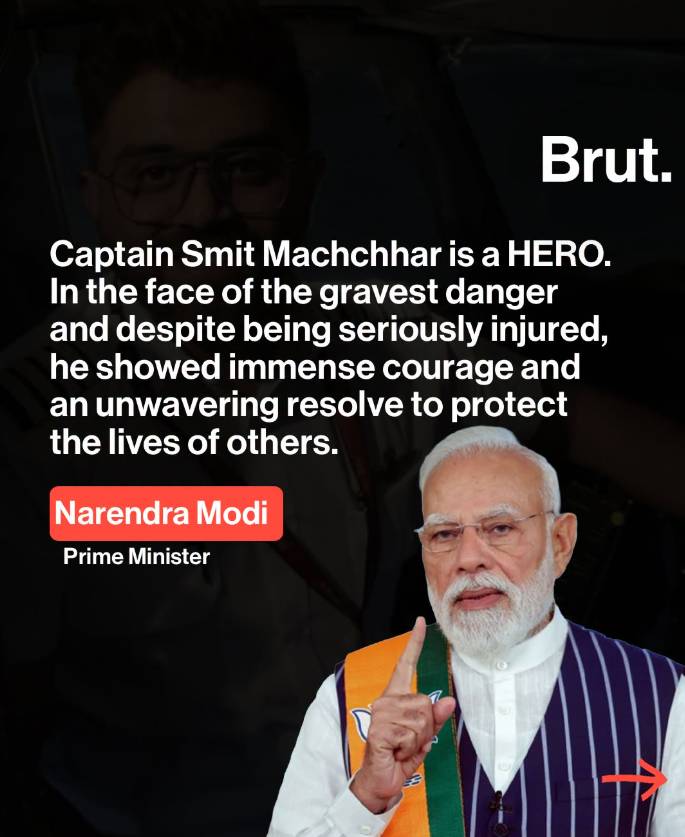
(Uncredited / Narendra Modi YouTube Channel via AP)
Reuters reported that both Indian Prime Minister Narendra Modi and Israeli Prime Minister Benjamin Netanyahu hailed Machchhar as a hero. Netanyahu described him as a “true hero,” while Modi praised his courage and resolve despite serious injury.
The Associated Press likewise reported that Machchhar was being hailed as a hero after thwarting the cockpit attack and enabling passengers and crew to restrain the attacker.
The Washington Post described him as an Indian pilot being hailed as a hero after the cockpit attack, highlighting the fact that his actions helped prevent a major tragedy.
The New York Times reported that Machchhar was being hailed as a hero after suffering stab wounds while fighting off his co-pilot, and highlighted praise from both Modi and Netanyahu.
CNN’s Japanese-language service also reported the international praise surrounding the Indian captain and described the circumstances in which he resisted the attack despite being stabbed.
The Guardian focused on the wider group of people involved in saving the aircraft, describing Machchhar as a hero and highlighting the contribution of passengers and other individuals aboard the flight.
This international reaction is significant.
The praise has not come only from Indian media.
It has appeared across major international news organisations and from political leaders in different countries.
The common thread is clear: Machchhar’s actions under extreme pressure are being recognised as extraordinary.
The Heroism Was Bigger Than One Man
There is another important lesson here.
The title How an Indian Hero Saved 180 Lives naturally puts the spotlight on Captain Machchhar.
And rightly so.
But the aircraft was ultimately saved through collective courage.
Passengers did not know exactly what they would find when they approached the cockpit.
They moved anyway.
Two off-duty pilots were available at a moment when professional flying expertise was desperately needed.
They stepped forward.
A medical professional among the passengers reportedly helped treat the wounded captain.
These actions demonstrate something fundamental about emergencies.
A crisis does not always reveal who has the loudest voice.
It reveals who is willing to act.
The passengers could have remained frozen in fear.
Instead, some moved toward the danger.
That courage deserves recognition alongside the captain’s actions.
The Attacker Must Face Full Investigation and Accountability
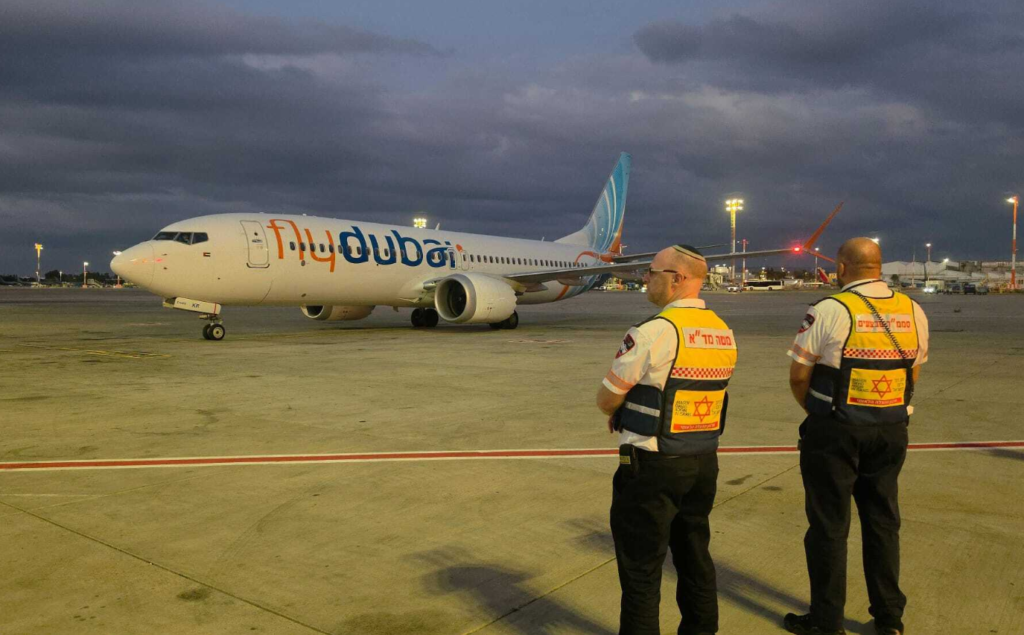
The alleged attack deserves equally serious attention.
There is a natural temptation after an extraordinary rescue to focus exclusively on the hero.
But the security question cannot be ignored.
How could a violent cockpit incident involving two professional pilots happen in the first place?
Why was an alleged attack possible during an international commercial flight?
What information was available about the co-pilot before the flight?
Were there warning signs?
Were existing security procedures followed correctly?
Were there gaps in crew screening, intelligence sharing or operational safeguards?
These questions cannot be answered responsibly through speculation.
They require a detailed investigation.
The reported attacker, an Omani national, was taken into Saudi custody, while authorities began examining the circumstances surrounding the incident. The motive remained unclear in initial reporting.
If investigators establish that the attack was deliberately intended to crash the aircraft, the consequences must be appropriately serious.
An aircraft carrying hundreds of people is not merely another workplace.
It is a highly sensitive security environment.
Violence inside a cockpit can become mass-casualty violence within seconds.
That is why any deliberate attempt to compromise an aircraft must be treated with the highest level of seriousness.
Why the Incident Was So Dangerous

Commercial aviation depends on layers of protection.
The cockpit is one of those layers.
Pilots are expected to operate as a team.
Aircraft systems are designed around redundancy.
Air traffic controllers provide external support.
Cabin crews monitor the passenger environment.
Security procedures exist before boarding.
Each layer is supposed to reinforce the others.
An attacker inside the cockpit potentially bypasses several of these safeguards simultaneously.
That is what made the reported attack so alarming.
The danger was not limited to the physical injury of one pilot.
The aircraft itself became vulnerable.
The reported rapid descent illustrates how quickly an emergency can escalate when control of an aircraft is compromised. Reuters reported that the aircraft dropped approximately 14,000 feet in under 30 seconds.
That is a frightening reminder of how little time may be available during a cockpit emergency.
What Can Be Done to Prevent Another Incident?
The heroism of Captain Machchhar should not become an excuse to accept unnecessary risk.
The better response to extraordinary courage is to ask how aviation systems can become strong enough that such courage is less likely to be needed.
1. Strengthen Continuous Crew Screening
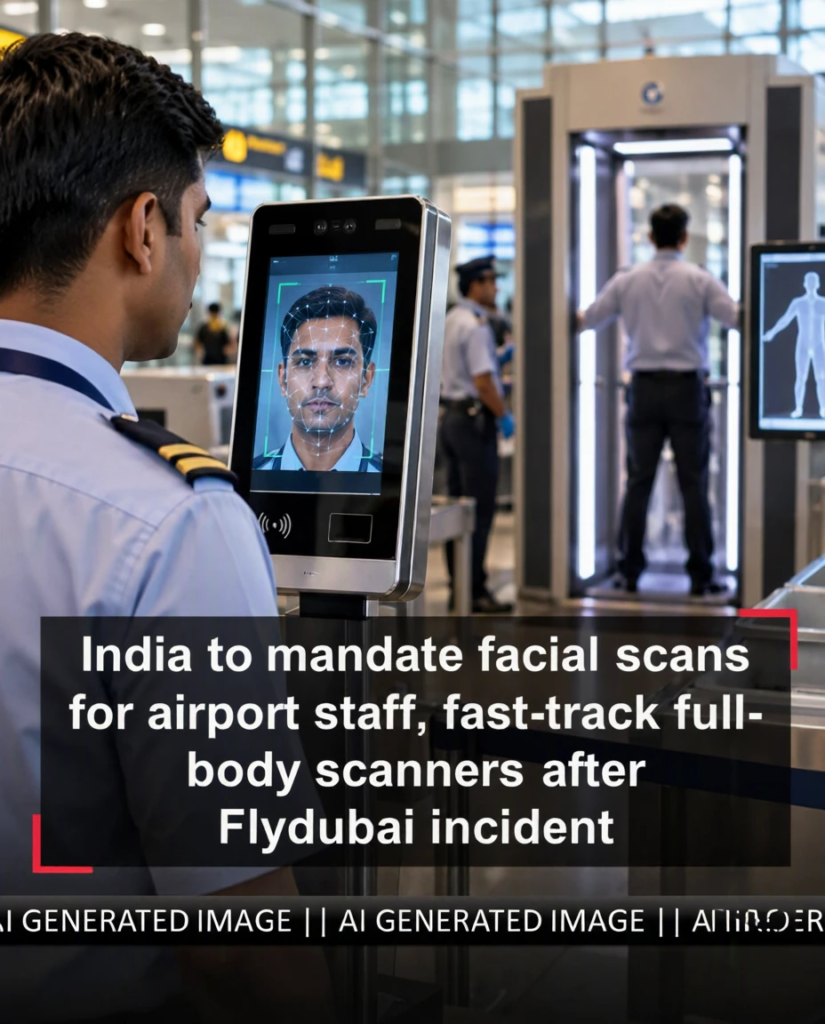
Aviation security should not stop when someone receives a pilot licence or joins an airline.
Crew members operate in highly sensitive environments.
Regular security assessments should therefore remain an important part of aviation safety, within applicable laws and privacy protections.
The objective should not be intrusive monitoring for its own sake.
It should be identifying credible security risks before they reach an aircraft.
2. Improve Information Sharing
International flights involve multiple jurisdictions.
A crew member may be employed in one country, operate an aircraft registered elsewhere and land in another country.
That creates complicated security challenges.
Relevant authorities therefore need effective mechanisms for sharing legitimate security information across borders.
The Flydubai incident demonstrates why aviation security cannot always be treated as an isolated national responsibility.
An international flight requires international cooperation.
3. Review Cockpit Access Procedures
The cockpit door exists for a reason.
After September 11, reinforced cockpit doors became a central feature of aviation security.
Yet emergencies can create unusual circumstances.
Authorities and airlines should examine whether existing emergency procedures provide adequate options when one cockpit occupant becomes violent toward another.
The goal should be a carefully tested system that protects cockpit security while allowing legitimate intervention during an extreme emergency.
4. Expand Emergency Training
Passengers are not trained security professionals.
They should never be expected to confront attackers as a normal part of air travel.
But airlines can continue improving emergency communication and passenger-awareness procedures.
Cabin crews should be equipped to recognise unusual situations quickly.
Pilots should have robust protocols for cockpit emergencies.
Airlines should regularly rehearse rare but catastrophic scenarios.
The objective is simple:
Prepare for the unlikely without creating unnecessary fear.
5. Strengthen International Aviation Cooperation
The aircraft travelled from Dubai toward Israel and ultimately landed in Saudi Arabia.
Three countries therefore became directly relevant to the emergency.
That illustrates the international nature of modern aviation.
Security standards cannot exist in isolation.
Airlines, regulators, airports, intelligence agencies and governments need mechanisms for rapid coordination when an aviation-security incident occurs.
The best security system is not one that works perfectly inside one country.
It is one that continues working when an aircraft crosses borders.
The Importance of Professionalism Under Pressure
There is a reason stories about pilots often resonate so deeply.
Passengers place enormous trust in the people sitting behind the cockpit door.
Most passengers never meet their pilots.
They may never know their names.
They simply trust that someone is there who knows what to do if something goes wrong.
Captain Machchhar’s reported actions offer an extraordinary example of that responsibility under the most extreme conditions.
His training could not have predicted every detail of what happened.
No checklist can fully capture every possible human threat.
But professional discipline matters precisely because emergencies are unpredictable.
When everything suddenly goes wrong, preparation can become instinct.
And instinct can become action.
That appears to be what happened aboard Flight FZ1073.
The Human Story Behind the Headlines
Behind the dramatic headlines is also a family waiting for news.
Captain Machchhar was reportedly born in Mumbai and had accumulated extensive flying experience. Reuters reported that he had previously worked for SpiceJet and was recovering in a Saudi hospital after undergoing treatment for his injuries.
The Washington Post reported that he had more than a decade of commercial flying experience.
His career story itself is striking.
According to Reuters, aviation was not originally his childhood ambition. He had considered joining his family’s textile business before developing an interest in flying as a young man.
Years later, that decision placed him in the cockpit at the exact moment when extraordinary courage was required.
There is something profoundly human about that.
A career choice made years ago suddenly became a responsibility affecting hundreds of strangers.
And when the moment arrived, he acted.
Why “180 Lives” Became the Symbol of the Story
The phrase How an Indian Hero Saved 180 Lives has spread because it communicates the scale of what was potentially at stake.
Strictly speaking, reports indicate that 174 passengers were aboard the aircraft. Some reporting and passenger accounts have used a figure around 180 for the total number of people whose lives were potentially at risk.
The exact number should not obscure the larger point.
Whether the figure is 174, around 180, or another total once the final manifest is fully documented, this was an aircraft carrying a large number of human beings.
Every one of them had a destination.
Every one had a family, friend, colleague or loved one somewhere on the ground.
That is what makes the reported attack so disturbing.
And that is what makes the rescue so powerful.
The number is not merely a statistic.
It represents hundreds of individual lives that continued because the aircraft reached the ground safely.
A Moment That Shows What Courage Really Means
Courage is often misunderstood.
It is easy to imagine courage as the absence of fear.
Real courage is different.
It is acting responsibly while fear and danger are present.
Captain Machchhar was reportedly seriously injured.
He had every reason to focus only on his own survival.
Instead, he fought back and opened the cockpit door.
That decision helped create the conditions for others to intervene.
His courage did not eliminate the danger instantly.
It created an opportunity for the danger to be stopped.
That distinction matters.
The passengers then acted.
The off-duty pilots acted.
Medical assistance was provided.
Emergency services responded.
The aircraft landed safely.
It was a chain.
And Captain Machchhar was one of its most important links.
The Right Response: Honour the Hero, Learn From the Failure
There are two ways society can respond to an incident like this.
The first is to celebrate the hero and move on.
The second is to celebrate the hero and investigate why the situation became possible in the first place.
The second response is far more valuable.
Captain Machchhar deserves recognition for extraordinary bravery.
The passengers who intervened deserve recognition too.
But the aviation industry must now ask uncomfortable questions.
Could screening have been improved?
Could warning signs have been detected?
Could communication between agencies have been better?
Could emergency cockpit procedures be strengthened?
Could pilots and cabin crews receive additional training for violent cockpit incidents?
These questions are not an insult to aviation professionals.
They are how safety systems improve.
Aviation became one of the safest forms of mass transportation precisely because the industry learned to treat accidents, near misses and security failures as opportunities to identify weaknesses.
The same principle should apply here.
The Legacy of Captain Smit Machchhar
For the moment, the most important thing is straightforward.
Captain Smit Machchhar survived.
The passengers survived.
The aircraft landed safely.
A potential catastrophe was avoided.
International leaders and major media organisations have recognised the extraordinary nature of the captain’s actions. Reuters, AP, The New York Times, The Washington Post, CNN and The Guardian have all reported the heroism surrounding the incident, while Modi and Netanyahu publicly praised Machchhar’s courage.
But the strongest tribute should not simply be another headline.
It should be a safer aviation system.
If this incident reveals weaknesses, those weaknesses should be identified.
If procedures worked, they should be strengthened.
If screening failed, the failure should be understood.
If emergency training helped, it should be expanded.
And if new safeguards are needed, they should be developed before another aircraft faces a similar nightmare.
That would turn an extraordinary act of bravery into something even more valuable: a lesson that protects lives long after the headlines disappear.
Conclusion: A Heroic Act, a Terrifying Warning
How an Indian Hero Saved 180 Lives is ultimately a story about courage in the face of an extraordinary threat.
Captain Smit Machchhar was reportedly stabbed inside the cockpit of a passenger aircraft.
The aircraft descended dramatically.
The situation became dangerously unstable.
Yet the injured captain fought back and managed to open the cockpit door, enabling passengers and crew to intervene. Other brave individuals then helped restrain the attacker, while off-duty pilots contributed to regaining control before the aircraft landed safely in Saudi Arabia.
The alleged attack itself deserves unequivocal condemnation if investigators establish that it was a deliberate attempt to harm passengers or crash the aircraft.
There is nothing political or ideological about the basic principle involved.
Deliberate violence against innocent people aboard a commercial aircraft is indefensible.
At the same time, responsible reporting requires waiting for investigators to establish the attacker’s precise motive and circumstances.
The facts already known are powerful enough.
An aircraft carrying 174 passengers faced a terrifying cockpit emergency.
A seriously injured Indian captain resisted.
Passengers stepped forward.
Other pilots helped.
The aircraft survived.
And hundreds of people returned to their families instead of becoming victims of a potential catastrophe.
That is why the story of How an Indian Hero Saved 180 Lives deserves to be remembered not merely as a dramatic aviation headline, but as a reminder of what courage, professionalism and collective action can accomplish when disaster appears only seconds away.
The next responsibility belongs to the aviation industry and security authorities:
Make sure that the next captain does not have to be this brave.