India’s young generation is finding new ways to make itself heard.
What started as an unusual online movement quickly developed into a much wider conversation about education, unemployment, accountability and the way institutions respond to young people.
The CJP Gen-Z Protests became one of the most striking examples of how India’s youth can use humour, social media and street mobilisation to challenge established systems.
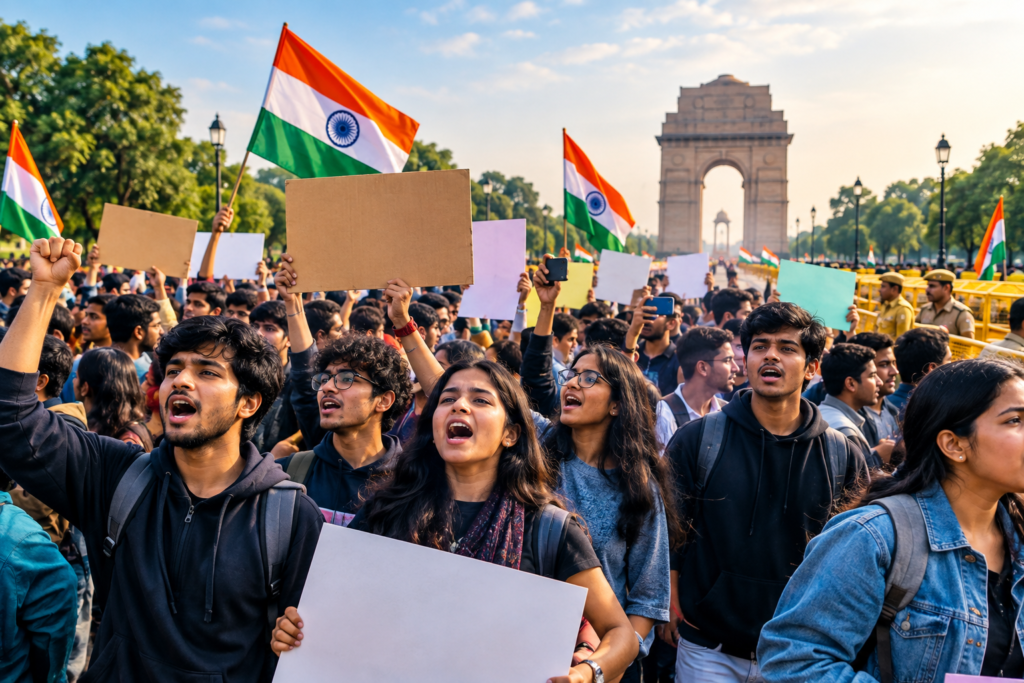
The movement’s unusual identity attracted attention.
Its demands created debate.
And its growing visibility raised an important question: Can a youth movement born on the internet actually create meaningful political pressure?
To understand the significance of the CJP Gen-Z Protests, it is worth looking beyond the viral videos, slogans and memes.
At its heart, the movement reflected a deeper frustration among young people who felt that important institutions were not adequately addressing their concerns.
Here are five powerful questions that explain why the movement matters.
Table of Contents
CJP Gen-Z Protests: What Actually Started the Movement?
The origins of the CJP Gen-Z Protests were very different from those of a traditional political movement.
There was no conventional political party with decades of history behind it.
Instead, the movement grew through social media, satire and growing dissatisfaction among young people.
The Cockroach Janta Party, commonly known as CJP, became associated with this new style of youth activism.
The unusual name itself helped attract attention.
Rather than allowing controversial language to define them, activists turned it into a symbol of resilience and resistance.
That was a clever strategy.
In the digital age, political movements do not always begin in conference rooms or party offices.
Sometimes they begin with a post, a video or a joke that suddenly connects with thousands of people.
The CJP Gen-Z Protests demonstrated how quickly that can happen.
The movement initially focused heavily on issues surrounding examinations and the difficulties faced by students preparing for highly competitive tests.
For many young people, these were not abstract political issues.
They were personal.
Students can spend years preparing for examinations. Families can invest substantial amounts of money and emotional energy in that preparation.
When serious irregularities occur, the consequences can be devastating.
That sense of frustration helped the movement grow.
Question 1: Why Did Gen Z Connect With CJP So Quickly?
One major reason was simple: CJP spoke the language of Gen Z.
Traditional political movements often rely on formal speeches, press conferences and conventional slogans.
The CJP Gen-Z Protests used something very different.
Memes.
Short videos.
Satire.
Social-media posts.
Viral slogans.
This approach made the movement accessible to a generation that spends much of its daily life online.
Social media was not merely a promotional tool for the protesters.
It became part of the movement itself.
Young participants could share their experiences, record events, express frustration and communicate with people hundreds of kilometres away.
A protester did not necessarily need to belong to a traditional organisation to participate.
They could contribute simply by sharing information or creating content.
That lowered the barrier to political participation.
The CJP Gen-Z Protests therefore demonstrated an important change in political communication.
Young people do not necessarily need traditional political structures to organise themselves.
They can build communities digitally and take those communities into the real world.
The combination of humour and anger also made the movement distinctive.
It was serious about its demands without always looking like a traditional political campaign.
That helped it capture public attention.
Question 2: Was the Movement Really About Examination Problems?
Examination issues were certainly an important part of the movement.
But the bigger story was about trust.
For students, an examination represents much more than a piece of paper.
It can represent years of preparation.
It can represent family expectations.
It can represent the possibility of employment or higher education.
And sometimes, it represents hope for a better future.
That is why examination controversies can produce such strong reactions.
The CJP Gen-Z Protests tapped into this frustration.
The protesters were not simply asking for one examination to be conducted properly.
They were raising questions about whether the broader system was fair and accountable.
What happens when students prepare honestly but believe others have gained an unfair advantage?
Who takes responsibility when administrative failures disrupt the lives of thousands of candidates?
What happens to young people who lose months or years because of irregularities?
These questions helped transform an apparently narrow issue into a much wider debate.
Education.
Employment.
Accountability.
Fairness.
The future of India’s youth.
That is why it would be too simplistic to describe the CJP Gen-Z Protests as merely an examination-related campaign.
The examination issue became a doorway into a much larger conversation.
Question 3: Did the CJP Gen-Z Protests Actually Challenge the System?
This is perhaps the most important question.
A protest can attract attention without producing meaningful change.
The real measure of a movement is whether it can influence institutions and public debate.
The CJP Gen-Z Protests succeeded in creating significant public attention around their concerns.
The movement also produced a powerful political moment with the resignation of Education Minister Dharmendra Pradhan in July 2026.
For supporters, that development represented more than a change in government personnel.
It demonstrated that sustained public pressure could have political consequences.
That was an important psychological victory.
Young people who had previously believed that their voices did not matter could now see that organised pressure could force institutions to respond.
But there is an important distinction.
Political pressure is not the same thing as systemic reform.
One resignation cannot fix an entire examination system.
It cannot eliminate unemployment.
It cannot solve every problem facing India’s education sector.
And it cannot automatically restore public trust.
This is where the future of the CJP Gen-Z Protests becomes complicated.
The movement may have demonstrated that it can challenge the system.
The harder task is proving that it can contribute to changing the system.
Question 4: Why Did the Movement Become Bigger Than Its Original Demands?
The answer lies in the broader frustrations facing young Indians.
For decades, education has been presented as one of the most reliable paths toward a better future.
Study hard.
Get qualified.
Find a good job.
Build a stable life.
But the journey is not always that straightforward.
Young people face intense competition for examinations, university places and employment opportunities.
Many spend years preparing for competitive examinations.
Others complete degrees without knowing whether suitable employment will be available afterward.
When problems emerge within institutions, frustration can quickly become anger.
The CJP Gen-Z Protests gave some of that frustration a common platform.
Different concerns could exist under the same movement.
Students could talk about examinations.
Job seekers could talk about employment.
Young activists could talk about accountability.
Others could simply demand that government institutions listen more carefully to their generation.
This made the movement broader than its original trigger.
It also explains why the movement attracted attention from people who were not directly involved in the examination system.
The underlying issue was not simply one test.
It was a question of whether young people felt confident about the systems shaping their future.
That is a much bigger political question.
Question 5: What Happens to CJP After the Protests?
This may ultimately determine the historical importance of the CJP Gen-Z Protests.
Starting a protest is difficult.
Keeping a movement alive after the initial excitement is even harder.
Once the headlines disappear, activists face difficult choices.
Should CJP remain a protest movement?
Should it become a political organisation?
Should it operate as a pressure group?
Or should it focus on specific issues at the local level?
The answers will shape its future.
The movement has already shown signs of expanding beyond its original examination-related concerns.
A broader focus on government schools, education quality and local accountability could potentially give CJP a longer-term purpose.
But this transition will not be easy.
Protesting requires mobilisation.
Reform requires patience.
It requires research.
It requires organisation.
And, most importantly, it requires practical solutions.
The future of the CJP Gen-Z Protests may therefore depend on whether the movement can move from criticism to constructive participation.
It is one thing to say that a system is broken.
It is another thing to explain exactly how that system should be fixed.
The Real Meaning of the CJP Gen-Z Protests
The biggest mistake would be to dismiss the movement as just another internet trend.
The memes matter.
The humour matters.
The unusual identity matters.
But they are not the whole story.
Behind the online culture is a generation asking serious questions about its future.
Young people want fair examinations.
They want better opportunities.
They want institutions to accept responsibility when things go wrong.
And they want their concerns to be taken seriously.
That is what gives the CJP Gen-Z Protests significance beyond their viral nature.
The movement also highlights how political activism is changing.
A young person does not necessarily need to join an established political party to participate in public life.
They can create content.
Build an online community.
Organise a local protest.
Share information.
And influence public discussion.
The internet has made political participation faster and more accessible.
But it has also created new challenges.
Online popularity does not automatically translate into effective policy.
Viral content can generate attention, but lasting reform requires sustained work.
That will be one of the biggest tests facing CJP.
CJP Gen-Z Protests: Revolution or Temporary Political Shock?
Calling the movement a revolution may be premature.
The CJP Gen-Z Protests have not fundamentally transformed India’s political system.
But calling them insignificant would be equally misleading.
The movement showed that a youth-led campaign can move rapidly from social media into the streets.
It showed that humour can become a political language.
And it showed that young people can organise around issues that directly affect their lives.
The resignation of the education minister also gave the movement a tangible political milestone.
But the deeper problems that contributed to the protests have not disappeared.
Education reform remains important.
Employment remains a major concern.
Institutional accountability remains essential.
And public trust takes time to rebuild.
The next stage may therefore be more important than the protests themselves.
The first challenge was getting attention.
The next challenge is turning that attention into lasting change.
What Can India Learn From the CJP Gen-Z Protests?
There is a broader lesson here for Indian politics.
Young people are no longer simply an audience for political communication.
They are becoming active participants.
They are creating their own political language.
They are questioning established institutions.
And they are increasingly comfortable organising outside traditional political structures.
The CJP Gen-Z Protests offer a glimpse of what that future could look like.
It may be more digital.
It may be more decentralised.
It may also be more unpredictable.
Political movements can emerge rapidly when a particular issue connects with a generation’s existing frustrations.
But movements also need direction.
Without clear goals, organisation and practical proposals, viral energy can disappear just as quickly as it arrives.
That is why CJP’s next steps matter.
If the movement can combine its powerful digital presence with serious policy engagement, it could become more than a moment of protest.
It could become a case study in how India’s Gen Z participates in public life.
Final Takeaway
The CJP Gen-Z Protests represent more than a viral youth movement.
They reflect a generation increasingly willing to question institutions that affect its education, employment and future.
The movement’s humour made it distinctive.
Social media made it powerful.
But its underlying concerns gave it meaning.
The central question now is not whether India’s youth can protest.
They have already demonstrated that they can.
The bigger question is whether protest can become reform.
Can online mobilisation produce lasting institutional change?
Can anger be converted into practical solutions?
And can a movement born from satire develop into a credible force for accountability?
Those questions will determine the lasting legacy of the CJP Gen-Z Protests.
For now, one thing is difficult to ignore:
India’s Gen Z is finding its political voice—and it does not sound like the generations that came before it.